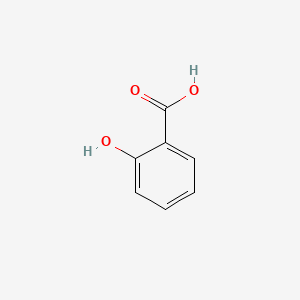
2-Hydroxybenzoic acid
CAS No.: 69-72-7
- Molecular Formula: C₇H₆O₃
- Molecular Weight: 138.12 g/mol
Chemical type
- Plant hormone (phytohormone)
- Plant hormone
- Defense signal
Key properties
- Endogenous signaling molecule
- Regulates immune responses and systemic resistance
- Downregulated by certain mVOCs in favor of JA pathways
- Induces ROS accumulation and AQP internalization
- Reduces membrane water permeability
- Interacts with ABA and JA pathways
- Key signaling molecule mediating Systemic Acquired Resistance (SAR)
- Its pathway is modulated by T. harzianum
- Levels increase in plants inoculated with T. harzianum
- Activates defense genes and pathogen resistance
- Influences root architecture and herbivore interactions
- Coordinates with other hormones for stress adaptation
- Modulates root hydraulic conductivity under stress
- Links redox signaling to water transport
- Enhances tolerance in mycorrhizal symbiosis
- Indirect pest control by activating plant defense responses against pests and pathogens.
Classification by use
- Regulators of plant development and defense
- Components of hormonal crosstalk networks
- Hormonal regulators of AQP trafficking
- Chemicals in defense and abiotic stress responses
- Plant defense elicitor
A trustworthy factory and manufacturer
- [1] Microbial volatile organic compounds reshape plant hormonal networks and root herbivore defense, Current Plant Biology, Volume 45, January 2026, 100584
- [2] Systematic Review of Plant AQPs: Molecular mechanisms, intracellular trafficking, and emerging roles in stress adaptation, Current Plant Biology, Volume 45, January 2026, 100586
- [Cite:3] Trichoderma harzianum for the control of agricultural pests: Potential, progress, applications and future prospectsControl de plagas agrícolas con Trichoderma harzianum: potencial, avances, aplicaciones y perspectivas futuras, Revista Argentina de Microbiología, 11 October 2025