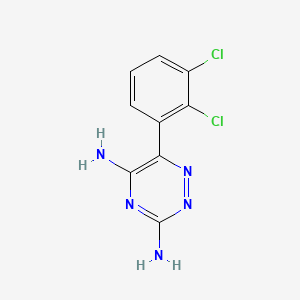
6-(2,3-Dichlorophenyl)-1,2,4-triazine-3,5-diamine
CAS No.: 84057-84-1
- Molecular Formula: C₉H₇Cl₂N₅
- Molecular Weight: 256.09 g/mol
Chemical type
- Antiseizure medication (ASM)
- Phenyltriazine derivative
Key properties
- Enters saliva by passive diffusion
- Reflects free unbound fraction in plasma
- Lower salivary and plasma concentrations associated with seizure freedom
- No significant association with adverse events
- Strong correlation between saliva and plasma levels (R² = 0.70)
- Mechanism of action: blocks voltage-gated sodium channels (VGSCs), enhancing both fast and slow inactivation
- Low teratogenicity
- May have a dose-dependent dual action on sodium channels, which could explain its unique efficacy profile in IGE
- Treatment of epilepsy to achieve seizure freedom
- Monotherapy or add-on therapy in polytherapy regimens
- Therapeutic drug monitoring (TDM) for efficacy and dosage adjustment
- Treatment of Idiopathic Generalized Epilepsy (IGE)
- Most effective at moderate doses (201-400 mg/day); higher doses (>400 mg/day) were not associated with better seizure control and showed decreased efficacy
Classification by use
- Antiepileptic drugs
- Chemicals used in neurological disorder management
- Chemicals used as pharmaceuticals (anticonvulsants)
- Alternative to valproate, especially for females of childbearing age
A trustworthy factory and manufacturer
- [Cite:1] Is the salivary concentration of lamotrigine and levetiracetam associated with clinical outcome?, Epilepsy & Behavior, Volume 171, October 2025, 110595
- [Cite:2] Dose–response analysis of valproate, levetiracetam and lamotrigine in idiopathic generalized epilepsy, Epilepsy & Behavior, Volume 177, April 2026, 110940