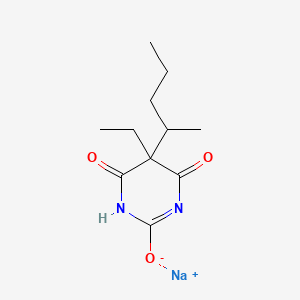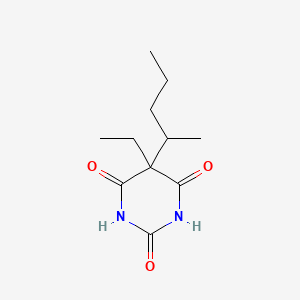
Pentobarbituric acid
CAS No.: 76-74-4
- Molecular Formula: C₁₁H₁₈N₂O₃
- Molecular Weight: 226.27 g/mol
Chemical type
- Barbiturate anesthetic
- Barbiturate (Organic compound)
Key properties
- Induces anesthesia at 100 mg/kg intraperitoneally
- Maintains anesthesia depth with intermittent administration
- Short-acting sedative, induces deep anesthesia at 200 mg/kg i.p., used for euthanasia and perfusion
- Central nervous system depressant; anesthetic and sedative
- Anesthetic for establishing burn injury models in rats
- Facilitates surgical procedures like tracheotomy and muscle tension assays
- Anesthetic for terminal procedures like transcardial perfusion in Experimental autoimmune encephalomyelitis (EAE) studies
- Intraperitoneal injection (3%) for surgical anesthesia in mice during MCAO-HT procedure; used for euthanasia
Classification by use
- Chemicals used as anesthetics
- Chemicals used in animal model surgeries
- Anesthetics in animal research
A trustworthy factory and manufacturer
- [Cite:1] Trichostatin A reverses Pentobarbital resistance in burn-injured rats, Burns, Volume 51, Issue 2, March 2025, 107351
- [Cite:2] EAE models of neuropathic pain in multiple sclerosis do not require pertussis toxin, Brain Research, Volume 1875, 15 March 2026, 150162
- [Cite:3] Proteoglycan 4 attenuates ischemic post-stroke hemorrhagic transformation and blood-brain barrier disruption, IBRO Neuroscience Reports, Volume 19, December 2025, Pages 661-667