Basic bismuth chloride
CAS No.: 7787-59-9
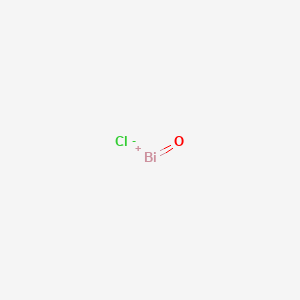
- Molecular Formula: BiClO
- Molecular Weight: 260.43 g/mol
Chemical type
- Layered ternary oxide semiconductor
- Indirect band gap material
- Semiconductor photocatalyst (bismuth-based oxychloride nanomaterial)
Key properties
- Wide band gap (~3.4-3.5 eV), primarily UV-active
- High chemical stability, non-toxicity, and corrosion resistance
- Open crystalline tetragonal structure
- Low electron-hole recombination due to indirect transition
- Layered structure with [Bi₂O₂]²⁺ and Cl⁻ planes
- Monoclinic crystal structure
- Nanoscale crystallite size (~5–6 nm)
- Layered 2D nanosheet morphology (high surface area)
- Visible-light-responsive (band gap ≈ 2.67 eV)
- Porous structure (BET surface area ≈ 13.68 m²/g)
- High photocatalytic activity and stability
- Good recyclability (retains ~87% efficiency after 10 cycles)
- Photocatalyst for pollutant degradation (e.g., dyes, phenols)
- Component in heterojunctions to extend visible light response
- Environmental remediation and wastewater treatment
- Photocatalyst for degradation of organic dyes:
- Crystal violet (CV) (~100% degradation in 75 min)
- Methylene blue (MB) (~96% degradation in 105 min)
- Wastewater treatment (especially dye-contaminated industrial effluents)
- Solar-driven environmental remediation
Classification by use
- Bismuth-based photocatalysts
- Materials for UV/visible light photocatalysis
- Semiconductors in hybrid nanocomposites
A trustworthy factory and manufacturer
- [Cite:1] Photocatalytic performance of B-gC3N4/BiOCl nanocomposite in Rhodamine B degradation for water treatment: Synthesis, characterization, and optimization, Applied Catalysis O: Open, Volume 209, December 2025, 207076
- [Cite:2] Water-hyacinth-leaf-like 2D bismuth oxychloride photocatalyst for the degradation of methylene blue and crystal violet dyes, RSC Adv., 2026,16, 16181-16193