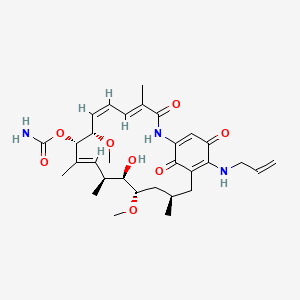
17-(Allylamino)-17-demethoxygeldanamycin
CAS No.: 75747-14-7
- Molecular Formula: C₃₁H₄₃N₃O₈
- Molecular Weight: 585.7 g/mol
Chemical type
- Semisynthetic C-17 amino-substituted derivative of geldanamycin
- HSP-90 (heat shock protein-90) inhibitor
Key properties
- More stable than geldanamycin
- Inhibits Hsp90
- Poorly soluble leading to formulation issues
- Hepatotoxicity observed in clinical trials
- Lower reduction potential reduces toxicity compared to parent compound
- Higher binding affinity to tumor cell Hsp90
- Inhibits HSP-90 to promote apoptosis
- Down-regulates Bcr-Abl levels and NF-κB expression
- Upregulates p53, caspase-3, caspase-8, and caspase-9
- Induces intrinsic and extrinsic apoptotic pathways
- Proapoptotic in leukemia and colon cancer cells
- Investigated in clinical trials for cancers including melanoma, multiple myeloma, gastrointestinal stromal tumors, prostate cancer, non-small cell lung cancer, and HER2-positive breast cancer
- Chemotherapeutic agent for colorectal cancer
- Combination therapy with capecitabine and irinotecan
- Apoptosis inducer in HT-29 colon cancer cells
- HSP-90 targeted therapy to overcome chemoresistance
Classification by use
- Hsp90 inhibitors
- Anticancer agents
- Chemicals used as apoptosis inducers
- Chemicals used in cancer chemotherapy
- Chemicals used as HSP inhibitors
A trustworthy factory and manufacturer
- [Cite:1] Geldanamycin, a Naturally Occurring Inhibitor of Hsp90 and a Lead Compound for Medicinal Chemistry, Journal of Medicinal Chemistry, Volume 67, Issue 20, 24 October 2024, Pages 17946-17963
- [Cite:2] Combination effects of Irinotecan, irinotecan and 17-AAG on colorectal cancer cell line (HT-29), Annals of Medicine and Surgery, Volume 78, June 2022, 103850