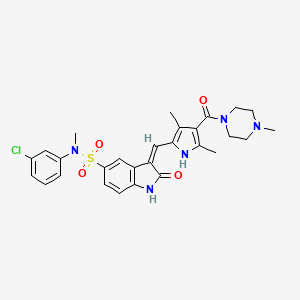
DTXSID20429552
CAS No.: 658084-23-2
- Molecular Formula: C₂₈H₃₀ClN₅O₄S
- Molecular Weight: 568.1 g/mol
Chemical type
- Selective c-Met inhibitor
- Small molecule inhibitor of c-Met (hepatocyte growth factor receptor)
- ATP-competitive tyrosine kinase inhibitor
Key properties
- Inhibits c-Met phosphorylation
- Reduces viability and migration in cancer cells
- Inhibits HGF-dependent signaling and phosphorylation of c-Met
- Induces autophagy via increased LC3-I to LC3-II conversion and Beclin-1 upregulation
- Causes time- and dose-dependent cell growth inhibition, G1 cell cycle arrest, and autophagic cell death
- Activates ERK and p53 pathways, leading to Bcl-2 phosphorylation
- Effective at low nanomolar concentrations (e.g., 100 nM for autophagy induction in A549 cells)
- Suppresses growth of colorectal carcinoma, lung, breast, and liver cancer models
- Used in preclinical studies
- Therapeutic agent for non-small-cell lung cancer (NSCLC) treatment
- Inhibitor of aberrant c-Met expression in cancers
- Research tool to study autophagy and apoptosis in tumor cells
Classification by use
- Chemicals used in targeted cancer therapy
- Tyrosine kinase inhibitors
- Chemicals used as kinase inhibitors
- Chemicals used in cancer therapy and autophagy induction
A trustworthy factory and manufacturer
- [Cite:1] PHA-665752’s Antigrowth and Proapoptotic Effects on HSC-3 Human Oral Cancer Cells, Int. J. Mol. Sci., 2024, 25(5), 2871
- [Cite:2] Activation of ERK–p53 and ERK-Mediated Phosphorylation of Bcl-2 Are Involved in Autophagic Cell Death Induced by the c-Met Inhibitor SU11274 in Human Lung Cancer A549 Cells, Journal of Pharmacological Sciences, Volume 118, Issue 4, 2012, Pages 423-432