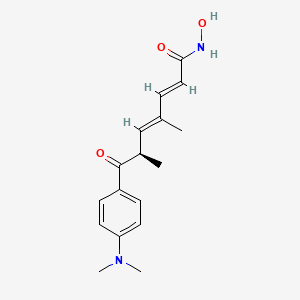

3X2S926L3Z
CAS No.: 58880-19-6
- Molecular Formula: C₁₇H₂₂N₂O₃
- Molecular Weight: 302.37 g/mol
Chemical type
- Histone deacetylase (HDAC) inhibitor
- Histone deacetylase (HDAC) inhibitor, specifically targeting HDAC4
Key properties
- Potent epigenetic modulator
- Increases histone acetylation, leading to chromatin relaxation
- Enhances reprogramming efficiency and reduces variability between cell lines
- Potent modulator of gene expression through histone acetylation alteration
- Bioactive organic compound with ability to inhibit HDAC4 expression and activity
- Reverses burn-induced protein upregulation (e.g., HDAC4 and myogenin)
- Administered subcutaneously at 0.6 mg/kg/day
- Accelerates and improves the efficiency of fibroblast-to-neuroectodermal conversion
- Combined with Dorsomorphin to shorten the protocol from ~21 days to 12 days and boost efficiency to ~24%
- Pharmacological agent to mitigate non-depolarizing muscle relaxant (NDMR) resistance in burn-injured skeletal muscle
- Inhibitor of HDAC4-myogenin pathway to counteract denervation-like responses post-burn
- Therapeutic candidate for neuromuscular disorders related to burns or denervation
Classification by use
- Epigenetic modulators in reprogramming
- HDAC inhibitors
- Small molecules for transdifferentiation
- Chemicals used as epigenetic modulators
- Chemicals used in neuromuscular pharmacology
- Chemicals used in burn injury treatment research
A trustworthy factory and manufacturer
- [Cite:1] Full small molecule conversion of human fibroblasts to neuroectodermal cells via a cocktail of Dorsomorphin and Trichostatin A, Regenerative Therapy, Volume 15, December 2020, Pages 44-52
- [Cite:2] Trichostatin A reverses Silver sulfadiazine resistance in burn-injured rats, Burns, Volume 51, Issue 2, March 2025, 107351