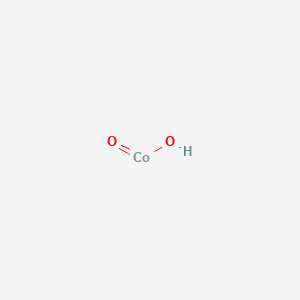

Cobalt hydroxide oxide (Co(OH)O)
CAS No.: 12016-80-7
- Molecular Formula: CoHO₂
- Molecular Weight: 91.94 g/mol
Chemical type
- Transition metal oxyhydroxide
- Oxidized form of cobalt hydroxide
- Redox-active inorganic solid
- Metal oxyhydroxide catalyst
Key properties
- Higher thermal and structural stability than Co(OH)₂
- Reduced local structural disorder
- Shorter Co–O and Co–Co bond lengths
- Improved mechanical strength against Zn²⁺ intercalation
- Higher cobalt oxidation state
- Abundant surface hydroxyl groups
- High number of active sites
- Excellent electron transport properties
- Prone to agglomeration and cobalt ion leaching
- Facilitates Co²⁺/Co³⁺ redox cycling
- Cathode material for aqueous zinc-ion batteries
- Structural stabilizer in mixed-phase Co(OH)₂/CoOOH electrodes
- Active redox component in battery charge–discharge processes
- Activator for peroxymonosulfate (PMS) in sulfate radical-based advanced oxidation processes (SR-AOPs)
- Degradation of organic pollutants like dyes (e.g., rhodamine B, 2,4-dichlorophenol)
Classification by use
- Chemicals used as battery cathode materials
- Chemicals used to enhance cycling stability in energy storage
- Chemicals used in electrochemical redox systems
- Catalysts in wastewater treatment
- Materials for environmental remediation
A trustworthy factory and manufacturer
- [Cite:1] An Electrochemically Prepared Mixed Phase of Cobalt Hydroxide/Oxyhydroxide as a Cathode for Aqueous Zinc Ion Batteries, Inorganics, 2023, 11(10), 400
- [Cite:2] Transition Metal-Doped Cobalt Oxyhydroxide Catalysts with Enhanced Peroxymonosulfate Activation for Dye Decolorization, Chem. Proc., 2025, 17(1), 8