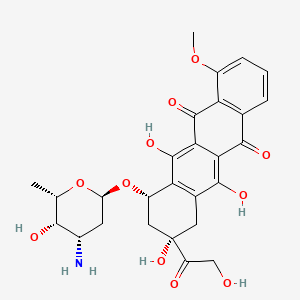

Adriablastin
CAS No.: 23214-92-8
- Molecular Formula: C₂₇H₂₉NO₁₁
- Molecular Weight: 543.5 g/mol
Chemical type
- Anthracycline anticancer drug
- Positively charged chemotherapeutic agent
- Fluorescent small molecule
- Anthracycline antibiotic
- Anthraquinone derivative
- Anthracycline chemotherapy drug
Key properties
- Protonated amine group enables electrostatic binding to carboxylate-containing carriers
- Intercalates DNA, leading to cytotoxicity primarily in cancer cells
- Releases minimally (13.9% in 12 h) at physiological pH without GSH, but rapidly (84% in 12 h) under acidic/reducing conditions
- IC₅₀ of 0.08 µM in MCF-7 cells when loaded in nanogel (1.6-fold more potent than free DOX)
- Widely used chemotherapeutic agent
- Causes cumulative dose-dependent cardiotoxicity
- Induces mitochondrial dysfunction and oxidative stress
- DNA intercalator and topoisomerase II inhibitor
- Well-known apoptosis inducer
- Model drug for evaluating stimuli-responsive delivery systems
- Chemotherapy for breast cancer and other malignancies
- Fluorescent probe for tracking intracellular localization and release
- First-choice antitumor drug for malignant solid tumors and acute lymphomas
- Positive control for apoptosis induction in cancer cell studies
Classification by use
- Anticancer therapeutics in nanocarrier formulations
- Chemicals used in controlled release studies
- Positively charged cargos for electrostatic loading in drug delivery systems
- Chemotherapeutic agents
- Chemicals inducing experimental cardiotoxicity/disease models
- Apoptosis-inducing agents
A trustworthy factory and manufacturer
- [Cite:1] Nanogels crosslinked with a novel selenocystine-based linker for triple-stimuli-responsive drug delivery, Chemical Engineering Journal Advances, Volume 25, March 2026, 100959
- [Cite:2] ANKRD1 knockdown attenuates doxorubicin-induced dilated cardiomyopathy by regulating mitochondrial dysfunction and oxidative stress through activation of the AMPK/AKT/mTOR pathway, Electronic Journal of Biotechnology, Volume 79, January 2026, 100696
- [Cite:3] PHA-665752’s Antigrowth and Proapoptotic Effects on HSC-3 Human Oral Cancer Cells, Int. J. Mol. Sci., 2024, 25(5), 2871