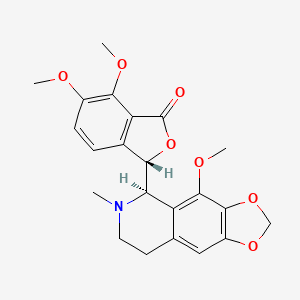

Tusscapine
CAS No.: 128-62-1
- Molecular Formula: C₂₂H₂₃NO₇
- Molecular Weight: 413.4 g/mol
Chemical type
- Natural alkaloid
- Benzylquinoline alkaloid (tetrahydroisoquinoline alkaloid)
Key properties
- Proven anticancer properties
- Disrupts PDK3 activity in cancer cells
- Modulates cancer metabolism by affecting the pyruvate dehydrogenase complex
- Induces apoptosis in tumor cells
- Shifts energy production away from glycolysis
- Promotes tumor growth inhibition under hypoxic conditions
- Synergistic with Radicicol for enhanced efficacy
- Reduces drug resistance and adverse effects compared to monotherapies
- Derived from Papaver somniferum (opium poppy)
- Exhibits low toxicity and high bioactivity
- Known for antitussive (anti-cough), anticancer, and neuroprotective effects
- Combinatorial therapy agent for lung cancer treatment
- Targeting Pyruvate Dehydrogenase Kinase 3 (PDK3)
- Inhibition of tumor progression
- Supported by computational docking analyses and cellular assays
- Historically used as an antitussive agent
- Investigated for its anticancer properties
- Explored in this study for its potential in Alzheimer's disease therapy via interaction with Lactoferrin
Classification by use
- Anticancer therapeutic agents
- Metabolic pathway modulators
- Synergistic drug combinations for oncology
- Phytochemicals / Alkaloids used in drug development
- Chemicals investigated for neurodegenerative disease therapy
- Potential anticancer agents
A trustworthy factory and manufacturer
- [Cite:1] Combinatorial Therapy Using Noscapine and Radicicol for Enhanced Treatment of Lung Cancer by targeting Pyruvate Dehydrogenase Kinase 3, Free Radical Biology and Medicine, Volume 240, Supplement 1, 15 November 2025, Page S31
- [Cite:2] Biophysical and computational insights into lactoferrin-noscapine interaction: Implications for neurodegenerative diseases, Biomedicine & Pharmacotherapy, Volume 187, June 2025, 118101