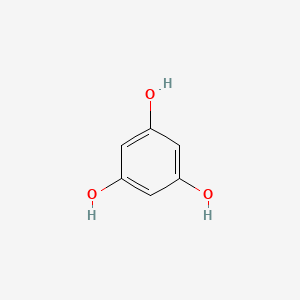
Benzene-1,3,5-triol
CAS No.: 108-73-6
- Molecular Formula: C₆H₆O₃
- Molecular Weight: 126.11 g/mol
Chemical type
- 1,3,5-Trihydroxybenzene
- Peroxidase inhibitor (PXDN, LPO, TPO)
- Mechanism-based or tight-binding irreversible inhibitor
Key properties
- Most potent inhibitor of PXDN halogenation and peroxidation activity
- Nanomolar IC₅₀ for purified PXDN (0.137 µM in Amplex oxidation assay without bromide)
- IC₅₀ of 0.948 µM in Amplex oxidation assay with bromide
- IC₅₀ of 0.95 µM for inhibiting HOBr-mediated collagen IV cross-linking in decellularized ECM
- IC₅₀ of 1.6 µM for inhibiting collagen IV cross-linking in cell culture
- Forms covalent adduct or tightly binds to PXDN active site, preventing reversion to native enzyme
- Does not form Compound II or III; causes unique spectral changes at 440 nm and 480 nm
- Irreversible inhibition not strictly dependent on preincubation with H₂O₂
- Inhibits PXDN to reduce oxidative stress and inflammation in pathologies
- Potential therapeutic for cardiovascular diseases (e.g., hypertension, atherosclerosis, cardiac fibrosis)
- Potential therapeutic for cancer progression and metastasis
- Potential therapeutic for tissue fibrosis
- Lead compound for designing specific PXDN inhibitors
- Tool for high-throughput screening in PXDN inhibition assays
Classification by use
- Irreversible enzyme inhibitors
- Inhibitors of halogenation cycle in peroxidases
- Antioxidants targeting hypohalous acid production
- Compounds for ECM remodeling studies
A trustworthy factory and manufacturer
- Peroxidasin Inhibition by Phloroglucinol and Other Peroxidase Inhibitors, Antioxidants, 2024, 13(1), 23