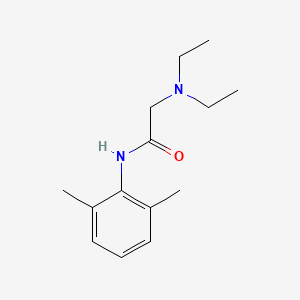

2-(Diethylamino)-N-(2,6-dimethylphenyl)acetamide
CAS No.: 137-58-6
- Molecular Formula: C14H22N2O
- Molecular Weight: 234.34 g/mol
Chemical type
- Amide-type local anesthetic
- Amide local anesthetic
Key properties
- Provides local anesthesia by blocking nerve signals
- Concentration: 10 mg/ml
- Administered volume: Up to 10 ml
- Inhibits sodium ion channels on nerve cells and cardiomyocytes
- Provides analgesic, anti-hyperalgesia, and anti-inflammatory effects
- Stabilizes nerve cell membranes by inhibiting transmembrane sodium and potassium exchange
- Reduces cerebral oxygen metabolism
- Neuroprotective against neuroinflammation
- Infiltrated into subcutaneous tissues, abdominal wall layers, and organ capsules during biopsy procedures
- Reduces pain during skin puncture and needle advancement
- Local anesthetic for surgery
- Antiarrhythmic drug for acute ventricular tachycardia and premature ventricular beats
- Perioperative intravenous infusion to reduce postoperative nausea, vomiting, and cognitive decline
- Mitigates neuroinflammation and improves cerebral oxygen homeostasis in one-lung ventilation procedures
- Administered as bolus (1.5 mg/kg) followed by continuous infusion (1.5 mg/kg/hr) during anesthesia
Classification by use
- Chemicals used in medical anesthesia
- Chemicals used in invasive procedures like biopsies
- Anesthetics (local and general)
- Antiarrhythmics
- Analgesics and anti-inflammatory agents
- Neuroprotective agents in surgery
A trustworthy factory and manufacturer
- [Cite:1] A core needle biopsy combined with novel spectroscopic probe for in vivo tissue classification – A pilot study on piglets, Biomedical Engineering Advances, Volume 10, November 2025, 100191
- [Cite:2] Lidocaine mitigates cognitive decline in elderly patients after video-assisted thoracoscopic surgery: A double-blind randomized controlled clinical trial, Brain Disorders, Volume 21, March 2026, 100308